Do Plastic Cutting Boards Shed Microplastics? What the Research Actually Says
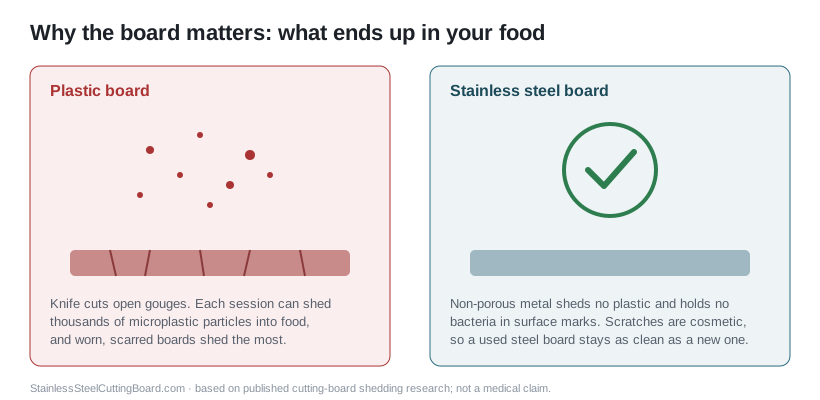
The short answer is yes, plastic cutting boards shed microplastics when you chop on them, and there's a peer-reviewed study that measured it. Think of it as the plastic board tax: a small amount of plastic that comes off the surface and into your food every time you use it, charged at every meal for the life of the board. The longer answer is more useful, because the internet has turned one study into both "your cutting board is poisoning you" and "microplastics are harmless, relax," and neither is what the science says. Here's the actual research, with citations, so you can decide for yourself.
The Study That Started It
In 2023, researchers at North Dakota State University published a paper in the American Chemical Society journal Environmental Science & Technology titled "Cutting Boards: An Overlooked Source of Microplastics in Human Food?" (Yadav et al., 2023). They chopped on polyethylene and polypropylene boards, the two most common plastics used for kitchen boards, and counted the particles that came off.
What they found:
- A single chopping session could release somewhere between 1,536 and 7,680 microplastic particles, depending on the board material, the person's chopping style, and how much force they used.
- Scaled up, they estimated a person could be exposed to roughly 14.5 to 71.9 million polyethylene microplastic particles per year from a board, and around 79.4 million particles per year from a polypropylene board.
- By mass, they estimated annual exposure of about 7.4 to 50.7 grams from a polyethylene board and up to 49.5 grams from a polypropylene board.
- Polypropylene boards shed more than polyethylene: 5 to 60% more by mass and 14 to 71% more by particle count.
- Chopping carrots on the board released more particles than chopping nothing, so real food contact increases the shedding, it doesn't reduce it.
Those numbers vary a lot for a reason: how you chop matters. A heavy hand on a soft, already-scored board sheds more than gentle work on a fresh one. The ranges are honest science, not sloppy measurement.
The Part Most Headlines Skip
The same NDSU team ran a basic toxicity check. They exposed mouse cells to the polyethylene microplastics and wood microparticles released during carrot chopping. Over 72 hours, they did not see a significant drop in cell viability. In plain English: in that specific lab test, the particles from the board didn't obviously kill the cells they were tested on.
That is not the same as "microplastics are safe." It means one narrow test didn't show acute cell death, and the researchers themselves called for more study on long-term effects. Anyone quoting this study to prove your board is dangerous, or to prove it's harmless, is overreaching. The study measured how much plastic comes off. It did not resolve what that plastic does to you over decades.
Why People Are Uneasy: Microplastics Are Turning Up in Human Bodies
The cutting board study lands harder because of what other researchers have been finding at the same time. This is separate research, and it's important to keep it separate: none of it is about cutting boards specifically. But it's the reason the topic feels urgent rather than academic.
Microplastics in human blood. In 2022, a team publishing in Environment International (Leslie et al.) reported the first detection and measurement of plastic particles in human blood, finding them in most of the samples they tested. It established that microplastics don't just pass through us; some get into circulation.
Microplastics in arteries, linked to cardiovascular events. In March 2024, the New England Journal of Medicine published a study (Marfella et al.) of 304 patients who had plaque surgically removed from their carotid arteries. Polyethylene was detected in the plaque of 58.4% of patients, and PVC in 12.1%. Over about 34 months of follow-up, patients whose plaque contained microplastics and nanoplastics had roughly a 4.5 times higher risk of heart attack, stroke, or death from any cause compared to patients with no detectable plastics.
Read that last one carefully, because it's easy to misuse. It's an association, not proof of cause. It cannot tell you that the plastic caused the heart attacks, and it says nothing about cutting boards as a source. It does tell you that microplastics reach human arteries and that their presence tracks with worse outcomes, which is a good enough reason to reduce obvious exposure where it's cheap to do so.
So What Do You Actually Do With This?
Here's our read, stated as opinion because that's what it is. The cutting board is the cheapest, lowest-effort microplastic source to eliminate in your kitchen, so eliminate it. A stainless steel board sheds exactly zero plastic. You lose nothing but a little knife-friendliness, which you can solve by keeping a wood board for delicate work. There's no downside worth weighing against "this is a real plastic source I can remove for $13 to $40."
What we won't do is tell you the board is making you sick. The evidence doesn't support that specific claim, and if we said it we'd be doing exactly what the clickbait sites do.
The Board Is the Easy One, Not the Biggest One
If microplastics are what brought you here, be honest about where the exposure actually concentrates. A cutting board sheds particles at room temperature. The bigger sources in most kitchens involve plastic plus heat:
- Scratched nonstick pans. Worn Teflon coatings can flake into food, and there's a growing case for retiring flaking nonstick cookware in favor of stainless or cast iron. It's the swap we'd rank above the board for anyone cooking on scratched pans daily.
- Plastic utensils in hot pans. A plastic spatula or spoon that lives in a simmering pot degrades far faster than a board does. Stainless and wood utensils are a cheap fix.
- Plastic storage heated in the microwave. Reheating in plastic containers is a well-documented way to move plastic into food. Glass costs a few dollars more.
The cutting board is the right place to start because it's visible and cheap. Just don't stop there and assume the job's done.
Want the whole plan, not just the board?
Get the free Non-Toxic Kitchen Swap Checklist: the 7 plastic sources in your kitchen ranked by how much they actually shed, and the cheap order to fix them in.
Download the checklist (PDF)Free, no email required. Opens as a one-page PDF.
Bottom line: Plastic cutting boards do shed microplastics, in the millions of particles per year range, and the amount goes up as the board gets scored and as you cut harder. Whether that specific exposure harms you is genuinely unproven. But it's one of the easiest plastic sources in your kitchen to remove for almost no money, and a stainless steel board removes it entirely. That's a clean trade even before the science is fully settled.